Why I changed the name of my game

They say that working titles should be so obviously bad that you don't get too attached to them. As I CTRL+F'd "Scroll & Steel" across several different documents, I thought, "Oh no."
I took a long time to come up with the name of my game. My names doc had about 25 names on it of varying qualities such as, "Spearhead Tactics," "Wardens of the Returning Dawn," "Questkin," and other such embarrassing names.
I eventually chose "Scroll & Steel" because it matched what I thought the game was. At the time, I knew the following about my game:
- It would take take combat and tactics seriously in a PBTA format
- Politics and factions were important themes
- It fit within the sword & sorcery framework, even if it wasn't dead center
- It mixed the magical and the mundane
Scroll & Steel hits some of those themes harder than others, but it also reflected a general insecurity about my game. I like that it had a comforting fantasy theme, but I struggled to say what was special about it. Every time someone asked me to pitch my game, I gave an awkward answer that reflected this insecurity.
Bonds as core
As I built and playtested my game, the bond mechanics became more and more prominent. I found a lot of good design space in making playbooks focused around making special types of bonds, like the Priest with gods, the Hunter with monsters, and the Fighter with the concept of fighting itself. As I referred back to Apocalypse World for first session and running the game advice (while I'm still developing those), I found a lot of things I really loved that I hadn't taken advantage of yet. For instance, PC-NPC-PC triangles are heavily emphasized in the book but something I never really implemented while running PBTA games, so I made creating those part of character creation. I was really intrigued by the way allies were put on the threat map, and my GM mechanics began to center around how to use bonds as threats and assets.
Eventually, the bonds mechanic became the game's special sauce. What I took to Metatopia specifically reflected this. My playtest sessions there were about players building relationships with each other and GM characters. I wanted to test whether or not this would give the GM enough material to twist and drive conflict out of. In general, it worked, and my own playtesting reflected this too. I quickly found myself unsatisfied with the threats I created and presented wholesale to players. Instead, I began focusing on how I could drive players to action by twisting and manipulating the bonds they created. Over time, I began to focus on this as the core of the game.
And, now that I knew what my game was about, it was time to find a title that reflected that. I was no longer satisfied with the generic fantasy offered by "Scroll & Steel." I wanted something that reflected how these bonds are both assets and threats: things the player can cling to and things that drive them apart.
Enter Cleave
"Cleave" is a funny word. It's a contronym, which means a word that also means its opposite. Cleave can mean both, "to hold tightly to," and also, "to split in two." It's the difference between cleaving to a loved one and cleaving an enemy.
This contrast is ultimately why I chose "Cleave" as the new title of my game. It evokes both elements of bonds that I want to explore. Bonds are assets and relationships you cling tightly to. Bonds are also going to be your main source of conflicts and will result in violence.
That last part is key. I knew, from its inception, that I wanted to feature violence in my game. However, I didn't want it to be context-less violence for the sake of violence. I wanted conflicts to erupt in it and make it feel like swords and fireballs are the only way to resolve the issues the players are facing, not just the easiest.
How the art reflects the title
With the new name came an excuse to include new art. I love Journey, Dean Spencer stock art that was the previous cover of my game, but the lone wanderer through a snowy landscape no longer fit the fantasy I wanted to convey. This was a game about people and civilization and the conflicts that arise when diverse people try to live together.
In my head, I imagined cover art that would look like it's being ripped apart. I had this image of a sword slicing the cover in half, but I wasn’t really sure what I wanted to have in the negative space or even what I wanted the sword to look like.
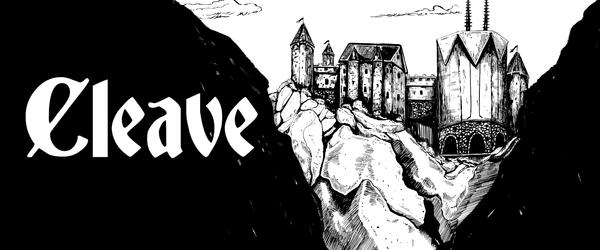
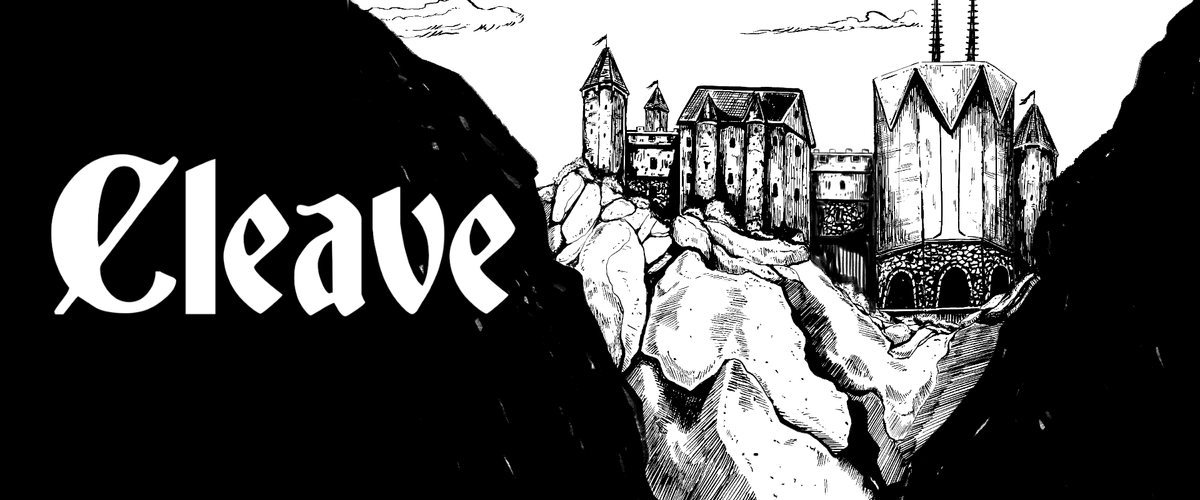
Enter Perplexing Ruins. I’ve been eying the stock art on this Patreon for a while. The art is incredibly evocative and I’ve been hoping that I’d have an excuse to use it. While browsing through the older images, I found an image of a settlement in a valley that was just perfect. And they even did an updated version after they saw I was using it!

What I love is that it evokes the image I was thinking of without being a direct translation. The dark valley emulates the “tear” that I was thinking of in a much more visually interesting way, and centering on a settlement communicates that the game is about community and people rather than context-less adventuring.
(On a side note, though it’s not related to the title, the new art I added from John Latta Art is a fantastic addition to the playbooks)
How it was received
Of course, I was worried that this change was going to result in a lot of wailing and gnashing of teeth. I had spent all this time promoting my game under one name, and now I was going to change it!?
Well, pretty much instantly, my post announcing the name change got more engagement and activity than my previous post for Scroll & Steel, and I got more downloads in a day than I had in a month.
So what I learned was that I was so bad at brand recognition that few people cared when I changed it. It turns out that being bad at marketing sometimes has its advantages.